Primo — Guide for Authors
Introduction
Welcome to PRIMO!!!!
Primo is a web based proofing framework which renders the xml file sent by the typesetter into the HTML version thus making it very easy for the authors to access it and edit. To those of us who are used to using word processors, this tool would be quite easy to use (except with a few additional quirks).
By providing extra features which would then help the author to get a glimpse of the final result of the processing, PRIMO ensures a smooth transition throughout the whole proof checking process.
Accessing your article proof

Step-by-step process of accessing the proof
- Step 1: As an author, you will receive an email from the publisher containing a link to the proof of your article.
- Step 2: By clicking on this link, you will be directed to the login page.
- Step 3: Registered Users, simply enter your credentials to sign in and view the proof of your article.
- Step 4: New Users, if you do not have an account, you will need to complete a brief sign-up process. Rest assured, the sign-up is straightforward and will grant you access to your article's proof.
- Step 5: Once you successfully sign-in/sign-up, you will reach the landing page.
- Step 6: Read the instructions in the landing page carefully.
- Step 7:Click on the Proceed button.
- Step 8: Yes, you have landed on the proof page. Now, start proof-reading and making changes.
The detailed instructions are provided in the following sections.
Sign up process
- Initiate Sign-Up: Click the'Sign-Up' link located at the top-right corner of the login page.
- Enter Your Details: Fill in a valid email address, choose a user ID (use only alphabets), create a strong password (with a mix of letters, numbers, and special characters), and enter your name in the respective fields.
- Complete Sign-Up: After entering the required information, click the 'Sign-Up' button to proceed to the proof page of your article.
- Record Your Credentials: Remember to save your login details securely. In the future, you can access the site using these credentials to sign in.
Landing page

Once you provided the credentials in the required field correctly, then you will be directed to the landing page.
- In the landing page, with
 and
and  placed at the top, you can see a brief info of the article on the left hand side and a part addressing the author as well as a few mandatory steps that need to be kept in mind before submitting the proof on the other side.
 - The
 tab functions to assist the author in making the proof checking process as easy as possible by providing instructions on the various functions and features that are available in the interface.
  can be accessed to get a video tutorial of the interface.
 can be accessed to get Elsevier's author guidelines.
- In order to start the proofing process, click
 to load the PRIMO proof page on the same tab. Alternative, by clicking on the downarrow near the button will provide an option to open the PRIMO proof page on a different tab.


Upon clicking the Proceed button, you will be directed to the PRIMO proofing page. The layout is strategically divided into three sections for optimal navigation:
- Center
- The Main Editor is positioned here, serving as your primary workspace for reviewing and editing your article.
- Left
- The Navigation Panel is located on this side, providing quick access to various sections of your document.
- Right
- The Track Change Panel is situated here, displaying all the editorial changes, comments, queries, attachments, Assets etc.
Recommended Workflow for Authors

The panels and tabs are organized to facilitate a smooth proofing process. Authors are encouraged to follow the sequence outlined below for an efficient review:
- Start with the Navigation Panel: Familiarize yourself with the document's structure and easily jump to different sections.
- Proceed to the Track Change Panel: Address any queries, editorial changes, and comments in the order they appear.
- Utilize the Main Editor: Make necessary revisions directly within your article, leveraging the insights from the other panels.
Note: This structured approach ensures a comprehensive and systematic review of your article before submission.
The Navigation Panel serves as your guide through the document's structure, allowing you to swiftly move between different sections. It lists all the key elements such as sections, figures, tables, formulas, TeX Instructions and Others is present in the article. All the subtabs when clicked display the respective contents under those header.Clicking on any item will directly take you to its location in the document, streamlining your editing process.
Note: While the system is equipped to handle various modifications, it is crucial to limit changes during this stage to those that are absolutely essential.
Front matter tab
Following the navigation tab, the 'Front Matter' tab is organised into sub-tabs for 'Head', 'Authors', 'Abstracts', 'Keywords', 'Nomenclature', and 'Salutation' each with its specific purpose. Based on the portion where you want to make the changes, you can make the edits in the associated fields provided within the tab.
The author can
- add short titles, footnotes, dedication
- add or delete the existing author names, to change order of author(Typesetter must get confirmation from Journal Manager(JM))
- edit the contents in Affiliations/Abstracts/Keywords
- edit corresponding author.
- Head

This section is divided into two parts:
- Non-Editable Meta Information: Contains fixed details like JID, AID, Article number, PII, DOI, and Copyright, which cannot be altered by authors.
- Editable Area: Located below the non-editable section, this area is presented in a form layout for ease of editing. Authors may choose to edit here or directly in the central editor. Different versions of titles like 'Subtitle', 'Alt title', 'Short title', 'Footnotes', etc. can be added, deleted or modified in the form mode as well as in the main editing area.
- Authors
During the proof correction stage, it is generally advised to avoid making changes to author details. Should any critical changes be necessary, they must receive approval from the Journal Manager. Under the Authors tab we have subtabs for Author details, Affiliations, Correspondences and Footnotes.
- Author: The details of the authors will be detailed there.
- Affiliations: Make necessary adjustments, including the reordering of affiliations. The system will automatically update the affiliation numbers to reflect any changes.
- Corresponding author details: This section displays the affiliation details of the corresponding author.
- Footnote: If applicable, this tab will contain a list of all footnotes associated with the article.;

The system does provide the following capabilities:
- Add/Edit/Remove Authors: Manage the list of authors as needed.
- Reorder Authors: Adjust the sequence of authors and switch between given names and surnames.
- Email Addresses: Update or remove existing email addresses, or add new ones.
- Contributor Roles: Define or modify the roles of each contributor.
- Affiliations: Link or update author affiliations.
- Corresponding Author: Designate or change the corresponding author.
- Footnotes: Add new footnotes and delete existing footnotes.
- Abstract tab

Contains the categories of Abstract , Graphical abstract as well as Highlights.
- Editing abstract portion: The edits can be made either in the field within this tab or directly in the main editor.
- Graphical Abstract: Graphical Images uploaded.
- Add/Edit/Remove highlights: Manage them as needed.
- Keywords tab

The keywords in the article will be displayed under this tab.
- Add/Edit/Remove keywords: Manage them as needed.
Body tab

Body comprises the main content of the Article which include Sections, Conflict of interest, Acknowledgments, Appendices and Nomenclature.
Sections
Section have options to insert new section, paragraph, credit statement and nested section and paragraph.
We can insert sections and paragraphs anywhere in the Body by clicking on the New tab. We can insert through either the field entry in the Left Panel under Sections tab or directly in the main editor. When we insert new sections and paragraph , the counters in the Article will also change accordingly.
Conflict of Interest
We can enter the details of Declaration of competing interest. The standard format is The authors declare that they have no known competing financial interest or personal relationships that could have appeared to influence the work reported in this paper.
Acknowledgements
This details of the Grant Sponsor and the Grant number associated with the Grant Sponsor will be displayed under Acknowledgements.
Appendices/ Supplementary Material

Electronic components (e-components, multimedia components) and other supplementary material not intended for publication in the paper product, or the Web version of the PDF, can be captured within appendices or in the main body of the text, depending on how the author has treated this material.
Nomenclature

Nomenclature provides the list of abbreviations. Nomenclature details the variables used in the article and its description. It should be inserted just above introduction or after frontmatter.
Back matter tab
In Primo there are different tabs visible when you click on the [Back matter]. These are all created as part of the Elsevier style that we are currently following.

Back Matter tab consists of subtabs for Reference, Data availability, Further Reading, Glossary and Biography.
Data Availability
Data Availability section contains a link to the dataset. It will be made available on request.
Further Reading
Articles referred by the author that are uncited usually come under the Further Reading. These uncited references can be moved to Further reading by the author using the contextual menu.

Glossary
Glossary lists the used abbreviated forms and its expansion in the article. Glossary list will appear after the Reference List.
Biography
The description about the authors of the Article.The author's name will appear in bold font.

In Primo once we have entered the Author's biography in the article we have to link it to the Author. The steps are explained below with pictures.
-
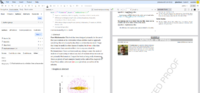
We have to navigate to the author's tab under front matter.
-
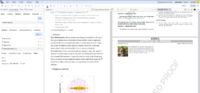
Select the author's name and click on the 'Other' in the lower panel.
-
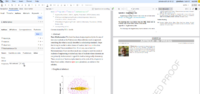
There is a field Biography and an Edit option near it.
-
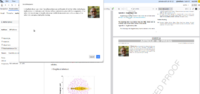
When we click on the edit option, a window with the biographer's detail pop-up as seen above.
-
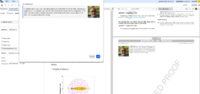
We have to select the biographer's detail and click on the okay button.
-
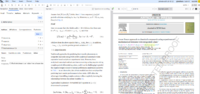
Once we click on okay we will see that the Biographer's field is with the information about the author. The author's name will be highlighted in the PDF.


Bibliography/References
When we click on the Bibliography section, we will see the references in the article listed. There is a new  tab, which when clicked ,a window will pop-up.Click on the insert-new bib reference and the fields to enter will be generated in the Left Panel.
See the below figure for the details of how to add a new reference.
-
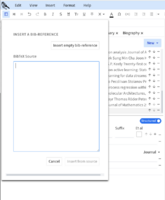
Click on new
 under reference and this window pops-up.We have to click on the Insert empty bib-reference.
-
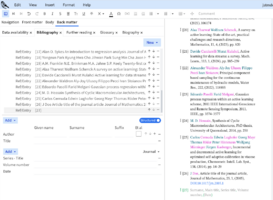
The Left Panel Fields to be filled in will appear, the same fields will be reflected in the Main Editor.
-
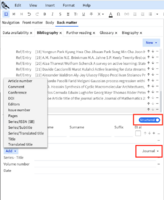
The Structured field is Journal and the entries in the Left Panel are related to Journal.You can add more fields by clicking the Add tab.
-
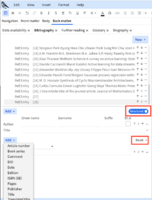
The Structured field is Book and the entries in the Left Panel are related to Book. You can add more fields by clicking the Add tab.
-
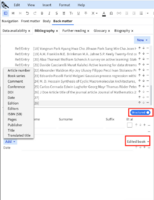
The Structured field is Edited book and the entries in the Left Panel are related to Edited Book. You can add more fields by clicking the Add tab.


The tail part of the article contains the bibliography data which might appear very difficult to edit. But, it’s simply making the changes in the right area.
- Helpful facts: Knowing a few facts which would make it more easy for you to make the necessary changes in Primo.
- There are different tabs visible when you click on the [Back matter]. These are all created as part of the Elsevier style that we are currently following. So, what you need to do is enter the relevant details in the specified fields and they will all be reflected in the main editor in the correct order. This makes it easy to cross check them.
- There are both structured as well as unstructured format that we can follow through in Primo. Currently, we have structured templates for Journal, book and Edited-book format. For other types of references, we can proceed with the unstructured format. By default, the reference is set in structured format.
- Reorder the reference list: Arrow marks seen at the end of each reference entry
 to be utilised to make the change, if deemed necessary.
 - Add/Edit/Remove reference details: Journal, book or edited-book details can all be managed as necessary in the respective fields made available in the provided template.

- In order to add a new reference entry, you can make use of the
 option seen on the top of the existing reference entries. Clicking on this triggers difference options such as [Reference from BibTex source], [Empty reference] and [Entry (nested)]. You may proceed based on the available data.
 - Editing any of the entries is possible. It can be done directly on the associated part in the main editor or in the related section displayed in the Back matter panel.
- For removing a specific entry from the list, simply click on the '-' option seen among . Another method is to directly remove it in the main editor.


 option are seen in two locations. Clicking on the first gives the provision of including new author, collaboration, comment,contribution, ellipsis, host, note, subtitle and translated title. Based on the available details to be added are related to journal, book or inbook, further data can be recorded in the second one.

- Editing platform: Either in the main editor or in the designated fields within the [Back matter] tab.
Keep in mind that all fields provided within the tabs are not mandatory. Therefore, go through each of the fields that are made available within these tabs and enter or edit the details that is available.
- If you need to add a new reference entry that doesn't have a specific template in Primo, then you can make use of the unstructured format.
- Step 1: Create a new reference using the [New] option above the reference list.
- Step 2: Select and ensure that Unstructured is highlighted in the page
 .
. - Step 3: The layout will change as result of opting for this. You need to focus only on changing the label according to the reference style and to insert the reference details without concerning about the order.

Track change panel
The track change panel, located on the right-hand side of the main editor, is an essential tool for authors during the proofing process. See the below Images for the tabs under Right Panel.
-
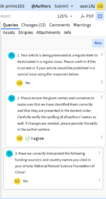
Queries
-
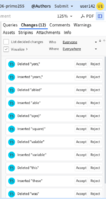
Changes
-
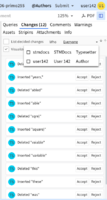
Changes-Who
-
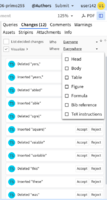
Changes-Where
-
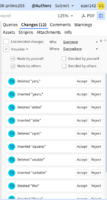
Changes-Visualize
-
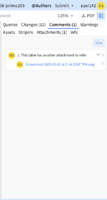
Comments
-
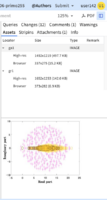
Assets
-
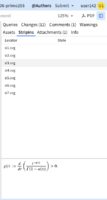
Stripins
-
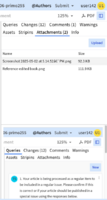
Attachments
-
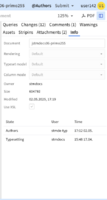
Info


It comprises several tabs, each serving a distinct purpose:
Queries
Start with the Queries tab to address any mandatory questions posed by the editors. These queries must be answered prior to submitting your proof.
Changes
Review the edits suggested by the language-editor or copy-editor. Each change is accompanied by 'Accept' or 'Reject' options, allowing you to decide whether to incorporate the suggested edits. Changes from the copy-editor are marked with 'CE', while your own changes will bear the initials from your login name.
Exploring more features of the Changes tab
- List decided changes
- Once you accept changes made by the copy-editor, they will no longer be visible in the track change tab. To review the changes you've accepted, enable the 'List Decided Changes' option, which will display all the edits you've accepted.
- Visualize
- This feature allows you to categorize and view changes based on::
- Made by yourself
- Made by others
- Decided by yourself (Your accepted changes)
- Decided by others (Others' accepted changes)
- Who/Everyone
- Use this filter to view changes made by a specific contributor or by everyone involved in the document.
- Where/Everywhere
- This function lets you focus on changes made to specific sections of the document, such as the front matter, figures, tables, equations, and more.
Comments
Use this tab to communicate any additional changes you'd like the typesetters to make on your behalf.
Assets
This tab displays all figures and supplementary materials linked to your article. For fast-rendering and using low band-width, the low-resolution images are shown within the editor, but you can view the high-resolution versions in the Assets tab.
Stripins
Stripins are mathematical images of equations in the article.
Attachments
The Attachments tab display all the figures, graphical abstracts and multimedia component entered in the Article.
Warnings
Any critical issues or deviations from the journal's guidelines, such as exceeding the allowed number of keywords, unreferenced bib etc will trigger warnings here.
Info
The Info tab details about all the information about the article.
Main editing area
Your article will be rendered in full in this area in HTML format with underlying XML. Whatever changes you make will be carried out automatically in the underlying XML from which the final PDF of your article is produced in web, print or any other format as required. To help you editing, there are two menu bars available — primary and secondary.
The primary one includes 
- Edit
- Includes cut, copy, paste, select all, find, replace, undo, redo, etc. and no need to explain the usages since it is common all editors.
- View
- In this menu, you can control how to view the main page. View the Editor only (center portion), Editor with panels (navigation panel, editor and track change panel), Editor with PDF (editor on the left-hand side and a generated PDF (up-to-date) on the right-hand side), Editor with PDF and panels. You may choose the appropriate one as per your convenience.
- Insert
- This is a contextual menu. You can insert different elements if the document structure allows to. For example, Only in the abstract field, you will find options to insert Author Abstract,Graphical abstract and Highlights. So the listing of possible elements in the menu depends on where your cursor is at present.

- Format
- Formatting your text. i.e., bold, italic, monospace, etc.
The secondary menu includes  .
Text formatting functionalities like (bold, italic, monospace, list etc.) are placed directly here in the secondary menu for quick access. So these does not need an explanation. However, there are some other features too which needs explanation.
.
Text formatting functionalities like (bold, italic, monospace, list etc.) are placed directly here in the secondary menu for quick access. So these does not need an explanation. However, there are some other features too which needs explanation.
- Toggle navigation panel
- Go to previous position
- Go to next position
- Undo
- Redo
- Insert special characters
- Non-breaking space (tie-up strings). Block two adjacent strings and press this button.
- Level-up (eg. change subsection to section)
- Level-down (eg. change section subsection)
- Bullets
- Numbering
- Move an object (equation, figure, table) here (first you have to select "Move" in that environment and use this.)
- Display PDF version of the article.
- Toggle change panel.
Options tab in Main Editor

There is an Options tab in the Main Editor on the top left. When we click on it, we will see a drop down Menu with options of the following. When each option is clicked we can view the various display.
- Browser: The Browser version is the default version of the Article.
- Proof: The Proof version when clicked will display the Proof PDF.
- Web: The Web version of the PDF will be displayed when we click on the Web option.
- Print: The Print version of the PDF will be displayed.
- Grid: Grid option when clicked in different versions will display the PDF with Grid.
- Tracked Changes: All the tracked changes in the Article will be displayed in the PDF when this option is clicked.
- Use XSL
- Auto Update on Edit: This option will be on default, where any edits made in the Article will be automatically updated in the PDF. If we untick this option the PDF will not be upto date.
- Report Problem: The Report Problem option when clicked a pop up window will open up. We can describe the problem and click on the Report button. The problem will be reported to the technical team and appropriate action will be taken to resolve it.
Head
Corresponding Author
The author to whom the communications regarding the file is addressed is the corresponding author. Usually the corresponding author is indicated by a '*' symbol followed by a footnote `corresponding author'.
Corresponding author is when there is only one author and one corresponding address affiliated to him. Corresponding authors is when there is more than one author with single affiliation.
| No. of authors | No. of corresponding authors | Affiliation of corresponding author | Out put |
|---|---|---|---|
| Multiple | Single | Single | Corresponding author. |
| Multiple | Two | Each with single affiliations | Corresponding authors. |
| Multiple | Multiple | Each with multiple affiliations | Corresponding author at: Affiliation. |
| Multiple | Single | Multiple | Corresponding author at: Affiliation. |
| Multiple | Single | Multiple affiliation that is not the corresponding affiliation | Correspondence to: Affiliation |
| Single author | Single author | Multiple affiliations but single corresponding affiliation | Correspondence to: Affiliation |
When a different affiliation is added other than an already existing affiliations we use Correspondence to.
-
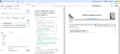
Corresponding author given to multiple authors and multiple affiliations
-
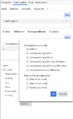
Corresponding author options display list
-
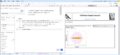
Corresponding author linked to an affiliation.
-
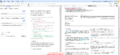
Two corresponding authors with different affiliations.


Affiliation
In Primo we can access the Affiliations under the Front matter on Left Panel. Under the Front matter there is Authors tab.The Second sub tab is Affiliations. The list of Affiliations in the article will be displayed here. We can select each Affiliation and the correspond field/text entries will be displayed in the lower panel. We can make edits in the field entries of each Affiliation selected.
In an Affiliation the following details are essential.
- Tags:
- organization
- address line
- city
- state
- pin code
- country
To add a new entry, under the Affiliations sub tab (Picture) there is a New tab which when clicked will display a field entry for the new affiliation to be added in the below list. We can click on the new field entry in the list and the lower panel will show all the text fields to be entered for New Affiliation.(Picture).
We can change the order of authors by using the up and down arrow key on the right side.(Picture) The changes will be reflected in the Main Editor simultaneously.
Abstract
An abstract is a brief summary of a research article, thesis, review, conference proceeding, or any in-depth analysis of a particular subject and is often used to help the reader quickly ascertain the paper’s purpose. In Primo, Abstracts are displayed in the Left Panel under Front matter. When we click on the Abstracts tab, we can view the Normal abstract, Graphical abstract and Highlights displayed.

In the Left Panel itself we can add new Abstracts by clicking on the New button .
How to upload a Graphical Abstract?
To insert a new Graphical abstract we must navigate to the Front matter > Abstract > .
We click on the New button and choose the option of Graphical abstract. Simultaneously we can see field entries for Graphical abstract in the Main Editor.
We must click on the field entry and navigate to Insert Menu and click on the Display and select the figure option. A pop up window appears where we can upload a figure. The preview of the figure will appear in the window. We must click on the ok button once we upload a figure. The uploaded graphical abstract will appear in the left panel, main editor and the PDF.
-
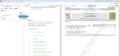
-
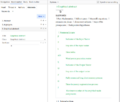
-
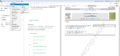
Click on the field entry and navigate to Insert Menu and click on the Display and select the figure option.
-
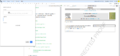
-
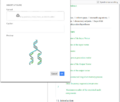
-
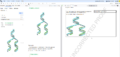


How to scale a Graphical abstract figure uploaded through Display option?
To scale a figure uploaded in Graphical abstract, we must right click on the picture and click on the option Figure image and select TeX pagination. A window will pop-up which will have the field to Scale. If you enter 0.15 in the Scale field, the graphical abstract will render correctly in the PDF.
-
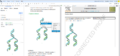
Right click on the picture and Figure image > TeX pagination.
-
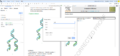
Pop-up window TeX pagination: Field Scale: Value=0.15.


Figures

There are different features in association with figures that have been incorporated into Primo.
Adding new figures: Follow these steps and you can insert a new figure in Primo within seconds.
- Step 1: Identify the place where you want to insert the figure. Make a simple click and ensure its spotted on the main editor.
- Step 2: Click on the [Insert] tab in the primary menu bar and select [Float] option which provides even more choices. Proceed with the [Figure] option among them.
- Step 3: The new pop up window provides you with an option to upload a new figure as well as enter its caption then itself. Click within the box that is shown below the [Upload] option and proceed to select the new figure from your system.
- Step 4:The preview of the figure will be seen below as a result. You can either type in the caption now or do it at a later point of time.
- Step 5: Click [Ok] and you can see the figure inserted in the main editor in the designated place.
Replace existing figures: Once you identify the figure that needs replacing, click on the three dots that are appearing along the figure caption and from the drop down options, select [Remove]. Once the figure has been deleted, you can upload the new figures using the earlier steps mentioned before.
Annotate in the figures: Since editing the figures are not possible in Primo as the processed figures would be included in the interface, the author may mention their requirements via annotations.
Scale the figure size: Scaling of figures are possible by making use of the [TeX pagination] option seen along with [Annotate] option. You can make changes by adjusting the width/ height/ angle or directly scale it by proving the measurement in the field given.
Insert inline and display figures: Adding inline figures are quite straight forward. Clicking where you want to insert this figure in the main editor, then target the [Insert] option in the primary menu bar and select [Inline figure] from the available options.
Tables
There are several features present in association with the Tables in the proofing tool. These features (which are permissible as per Elsevier's requirements) can easily be identified by right clicking anywhere inside the display tables.
- Adding new columns or rows:

If you need to add rows or colomns and whether you need to insert it above or below the specified space, all these can be easily implemented using these easy steps.
- Deleting any columns or rows:

Place the cursor on the row or column that you need to remove and right click to get the features available in association with the table. Select the [Delete] option and proceed accordingly.
- Merging cells in a column or row:

Place the cursor on the row or column that you need to merge and right click to see all the table related features. Depending on how we need the cells to be merged, select [Merge with] and choose the required tab from the available options.
- Aligning cells:

- Right click on the cells that you need to align.
- From the options seen on the screen, click [Cells] and then select the suitable option. Alignment can be done vertically and horizontally. So, choose the option wisely.
Textbox

Text box feature is included so as to present a figure, table, equations etc without any breaking and as a single character. It is incorporated into Primo and can be utilised using just a few steps.
- Identify the area and make a click where you want to insert the text box.
- Click on the [Insert] tab in the primary bar, then [Floats] and from there, select [Text Box] from the options available.
- You can now see the text box field successfully created in the main editor.
- In order to inside the content within the box, make a click inside the box and again click on the [Insert] option in the primary menu bar.
- This time, opt for [Display] option and based on the element you're planning to add, select them from the available options provided.
-
![Click on the [Insert] tab in the primary bar, then [Floats] and from there, select [Text Box] from the options available. The Text box field in the Main Editor.](/images/thumb/f/fb/Textboxfloattextbox.png/120px-Textboxfloattextbox.png)
Click on the [Insert] tab in the primary bar, then [Floats] and from there, select [Text Box] from the options available. The Text box field in the Main Editor.
-
![Click on the [Insert] tab in the primary bar, then Display and select the options available.](/images/thumb/8/89/TextboxDisplay.png/120px-TextboxDisplay.png)
Click on the [Insert] tab in the primary bar, then Display and select the options available.
-
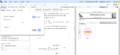
For eg:If formula is selected from the option, this box will appear and we can enter the formula to be displayed in the Textbox.
![Click on the [Insert] tab in the primary bar, then [Floats] and from there, select [Text Box] from the options available. The Text box field in the Main Editor.](/wiki/File:Textboxfloattextbox.png)
![Click on the [Insert] tab in the primary bar, then Display and select the options available.](/wiki/File:TextboxDisplay.png)

Cross reference
One of the notable features incorporated into Primo is the easiness with which you can add or edit a cross reference. It is no longer a tiresome or troubling task. Let's see how it can be done.
- Adding a new cross reference

Step 1: Just click on the space where you want to insert the cross-ref and you can add new cross refs by using the Hyper ref tab in [Insert] as shown in the figure.
Step 2:Clicking on this results in the opening of a new pop-up window. All the portions that can be cross referenced will be displayed in this window.
Step 3:Identify the portion to be referenced from the window and select them. Clicking once more on the same deselects them.
Step 4:As you make the selection, associated string and counter which will appear as the label in the article will be displayed in the top portion. Ensure that the correct label is displayed in the box available there.
Note: You can add multiple targets to be cross referenced within a single label.
Step 5:Then click [OK] to proceed. You can now see the result in the HTML editor.
- 'Editing an existing cross ref
If what you want is to change the already cross-referenced portion in the article, then just click on the specified cross-ref and you can see two options being displayed on the screen.

Then select the [Edit] option and delete or add the one that you need to cross-ref from the options available. Then click [OK] to proceed.
Math
Editing the existing formulas or equations

- In order to edit an equation displayed in the proof, simply click on the concerned equation. This will result in the opening of a pop up menu as seen above.
- If you are a LaTeX user, then you can, with ease, directly edit the data. If not, select the [Toggle virtual keyboard] tab displayed near the menu option in the pop up window.
- Make the changes you need in the equation part visible within the box and then click [OK] to complete the task. You can see the now edited equation displayed clearly in the interface.
Adding new equations or formulas in the article
Ste 1: First you need to identify where you want to create the new equation in the main editor.
Step 2: Once that's found, make a click and proceed to select the [Insert] option in the primary menu bar.
Step 3: Among features available, you can see [Math] option. Select this option.
It's also possible to add a new equation or formula using the existing ones also.

- You can insert a new formula by clicking the 3 dots appearing in the left of the equation number and click on [Insert after] or [Insert before] (depending on where we want to insert the new equation).
- Then find the [Formula] tab from options.
- Clicking on the [Formula] leads to the opening of the formula tab.
- Just as we did for editing the existing formula, if you are able to, you can directly note down the LaTeX commands for the new formula. If not, then select the [Toggle Virtual Keyboard] and type in the new formula.
- Finally, click [OK] to finish the task.
Frequently Asked Question (FAQ)
Where do the email address of the authors appear?
The email address of the authors appear in the form in the navigation panel in the "Authors" tab. So if you see any queries related to email address, navigate to the "Authors" tab, then select author whose email id needs updating. The form will display the author's current email address in the E-address field, which you can edit as necessary. Additionally, the author's email address is also included in the article's PDF version.
How to change the position of the figures?
Changing the figure position is not a nightmare at all now. All you need is to locate the figure that you need to move and an idea of where you need it to be. The position of the figure can be changed within the same page or moved to another page. Let's see how both these can be done in Primo.
- Within the same page.
It should be noted that all the floats will be placed at top by default. Currently, Primo makes it possible to place the top and at the bottom.
- Click on the 3 dots that is seen along the needed figure in the main editor.
- From the features that are displayed, select the [TeX float environment].
- In the new pop up window that has appeared as a result of this, you can see the second option as [Position].
- Selecting on the down arrow that is made available in the field associated with this, you can find the [Top] and [Bottom] options which can be utilised.
- Select on the preferred position from the list, click [Save] and close the window.
- Check the updated PDF to verify the changes.
- Moving the figure to a different page.

- After identifying the figure, you can find a dotted portion near the figure caption.
- A single click on the dotted area results in laying down the drop down menu which contains several options.
- Select the option [Move] and paste the figure to the desired position either by right clicking there and going for the [Move here] option or directly paste the figure there by using Ctrl+V.
- Cross check with the PDF output and ensure that the you're placing the figure in the correct page.
How to edit the figures?
Editing the figures is not possible as we are including the processed graphical images here. Therefore, if you need to insert or add any new edits to figures, then it's better to proceed to replace the figure with a newly uploaded one.
How to add the enunciations?

- Apart from formulas, enunciation can also be added using the proofing tool.
- Click on the space in the main editor where you want to add the enunciation.
- Then select [Insert] option from the menu bar and opt for the [Enunciation] tab from the available options.
- Clicking on the [Enunciation] tab leads to the opening of another pop-up window in which you can select the type and mention the title (which is optional) of the enunciation.
- After mentioning the details, click [OK] to complete the task.
How to add Graphical abstract?
Two ways to add Graphical abstract
--Frontmatter tab Insert Menu Abstract > New > Graphical abstract Abstract >Graphical abstract
Step 1: In the Frontmatter under the Abstract tab we can add new Graphical abstracts.
Step 2: Click on the New tab and select Graphical Abstract and title will be generated in the Main Editor.
Step 3:To insert a figure we must navigate to Insert menu and click on Display > Figure
See the below figure for details
-
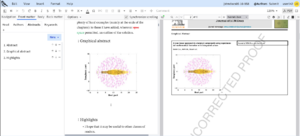
Frontmatter > Abstract > New
-
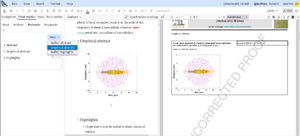
New > Graphical abstract
-
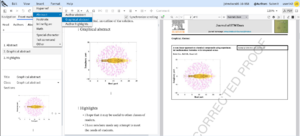
Insert Menu > Abstract > Graphical abstract
-
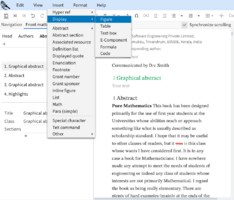
To insert a figure we must navigate to Insert menu and click on Display > Figure


How to add Highlights?
Two ways to add Graphical abstract
--Frontmatter tab Insert Menu Abstract > New > Author Highlights Abstract > Author Highlights
Step 1: In the Frontmatter under the Abstract tab we can add new Author Highlights.
Step 2: Click on the New tab and select Author Highlights and title will be generated in the Main Editor.
How to add Nomenclature?
How to add Glossary
Credit statement in Primo
Different authors would have contributed in different ways to the creation of an article. There are standard as well as non-standard roles created to signify this purpose. This content can be edited as per the authors’ choice by clicking on this section in the HTML viewer and making the changes directly there.
Step 1: Credit Statement field is generated in the Main Editor, by selecting the Credit Statement under the Insert Menu.
Step 2: Credit Author Statement will be the first in the Special Sections. We must place the cursor at the end of the Body part (Conclusion) in the Main Editor, and navigate to the Insert Menu.
Step 3: There we must select the Credit statement from the drop down menu.
Step 4: After the field has been generated, we must select the Authors under the Front matter. We will see the sub-tab Contributor roles.
Step 5: We can click on the New button in right side of the lower panel and choose the Roles from the drop down list.
Step 6: We have to select each author from the Authors list under the Author tab and then choose their contributor roles.
See the below figure for details
-
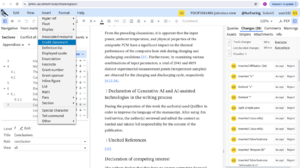
-
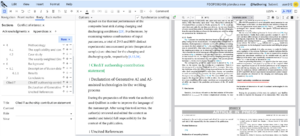
Credit authorship field generated.
-
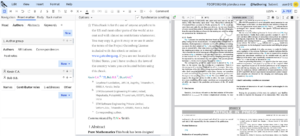
Front matter > Authors > Contributor Roles
-
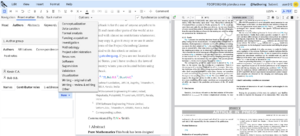
The Contributor Roles sub tab come under the author tab in front matter.
-
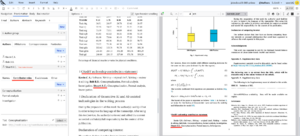
Third Author selected and the corresponding changes in Main Editor and PDF.
-
Checking optional parameters
-
Checking extra brackets \citet
-
Checking extra brackets \citep
-
Hard citations


You can check out the result by using the Toggle PDF view and get the PDF output of the article. If you are, in any way, unsatisfied with the change, you can either use the undo option or choose the Reject button in the Change tracker.
Declaration of Conflicting Interest section

Editing the DoCI section is a very easy process. You can find the section easily while going through the article in the HTML editor or by finding this section using the Navigation tab in the Toggle left sidebar. Once we find the part, just edit it as we do in any word processor. Check the final result using the Toggle PDF view.
How to add a new funding source in the interface?

The funding details such as the grant sponsors and grant numbers are included in the Acknowledgements section found above to the reference part. You can directly edit this in the HTML view or click where you want to place the new addition and opt for [Grant sponsor] or [Grant number] tab from the [Insert] menu.
- After selecting the name of the agency or organization that you need to make it to a grant sponsor, go to the [Insert] tab and select [Grant sponsor].
- We need to include the grant number associated with the grant sponsor in the article too. Hence, type in the grant number and then select it as we did with the sponsor.
- Proceed to click on [Grant number] from [Insert] menu which leads to the opening of a pop-up window from which you need to select the sponsor who is associated with the grant number you had selected.
- After selecting the sponsor, click [OK] to finish the task.
Supplementary materials

Editing the supplementary materials is not possible in the tool. Instead of editing, what can be done is upload the new material in the interface. This can be done by 2 ways.
- Using the [Assets] tab: In the [Assets] section, depending on the type of material provided, the details will be displayed alongside the processed graphical representations on the screen.
Click on the 3 dots found to the left of the size of the materials and select [Upload new high-res] option. Upload the necessary material from your system and mention this as a comment in the Comment section of the interface for the attention of the operators working in the stage of processing.
- Using E-components tab: Click on [Insert] tab and select [E-components] from the [Display] option. A pop up will open. Upload the relevant file using the [Upload] option, enter the caption in the specified field and press [OK] to complete the task.
Bibliography
Bibliography tab comes under the Backmatter. We can enter Bibliography in Author Year Format and Numbered.
Unreferenced bib
Author Year bib
How to change Numbered Reference to Author Year format.
Bibliography through Left Panel
When entering the a new reference or editing an existing one, it might appear a bit confusing as to which all details needed to be included and where it should be inserted.
Step 1: The first thing to do is identify where you want to insert the new reference in the main editor.
Step 2: Once that is confirmed, keep the cursor on that point in the Reference section of Article and navigate to the Left Panel.
Step 3: On the Left Panel, under the tab Backmatter we will find Bibliography. Click on that tab and the References in the Article will be listed.
Step 4: The cursor position will be reflected and the Reference will be highlighted in the Left Panel.
Step 5: We have to click on the New tab and select the Reference Option.
Step 6: A window with 'Insert empty bib-reference' option with appear, click on it and the fields to enter the new reference details has been created.
Step 7: We have to enter details through the given field entries in the Left Panel. They will be populated in the Main Editor and PDF.
- Kindly note that reference style set in Primo is numbered by default. You can change it any time.
-
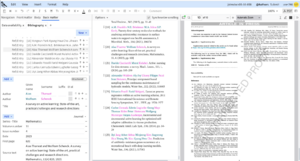
Step 1,2,3 and 4
-
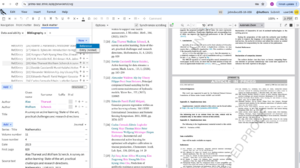
Step 5 - New tab
-
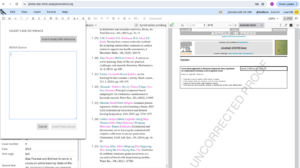
Step 6 - Insert Empty bib-reference Window
-
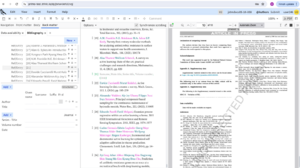
Field Entries in Navigation Left Panel and Main Editor
-
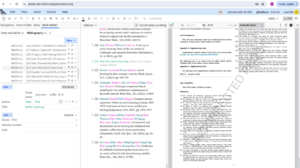
Author - Title Field Entries
-
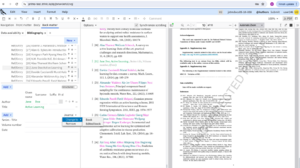
We can change the Reference genre to Book, Edited book
-
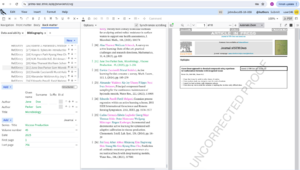
Sample - Journal details entered
-
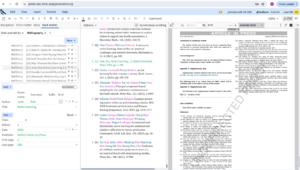
Sample - Book details entered
-
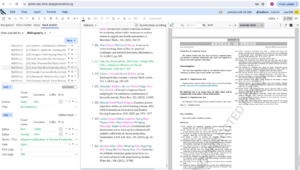
Sample - Edited Book details entered
-
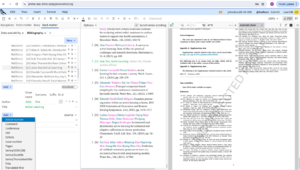
Bib-item information
-
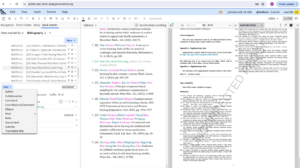
Bib-item information


Just click within this field and proceed to enter the relevant details in the associated tabs in the left.
The data that needs to be entered, depending on the type of reference (Journal, Book, Edited book), might be a bit different. So, take a sample representing each of these categories and see how the details are recorded.
- Article



Now let's break up the reference and list out each item.
- Author name: Antic C
- Article title: Analogical proportions
- Journal title: Ann. Math. Artif. Intell
- Volume: 90
- Year of Publication: 2022
- Page numbers: 595-644
[Authors] section
- Authors' names: In order to edit or add authors to a reference, you can click on the [Authors] tab . The author name can be added in the [Surname name] and [Given name] respectively.
[Titles] section
- Titles: The title of the article can be included in the [Titles] section. A specific field for Titles can be found as the first option there. You can record the article title here.
- Journal title: In order to enter the journal title, you have to enter in the Left Panel. You can find [Title] as the first field there. The journal title needs to be documented here.
- Page number: Page number is added in the Left Panel. Mention the first and last page number in the specified fields respectively.
- Volume number: Volume number can be entered in the field created solely for this purpose.
- Published date: Date (or year) of publishing of the referenced item is noted in the "Date" field created in the Left Panel.
- DOI: If you need to add any DOI link associated with the reference item, then this can be inserted in the "DOI" field in the Left Panel. Here, it's not available so we can leave it blank.
Edited Book When recording the data of a bib type such as "Edited Book", it involves a slightly different set of details compared to a journal. References with multiple titles usually come under "Edited Book" category. So, lets explain and learn it easier with an example.


Let's list out each part of the bib item for more clarity.
- Author names: Galanter P
- Article title: Generative art theory
- Editor's name: Paul C
- Book title: A companion to Digital Art
- Date of publication: 2016
- Publisher: John Wiley & Sons
- City: Oxford
- Page number: pp. 146-180
Now we just need to add these elements in the correct fields.
[Authors] section
- Using the
 tab, you are able to add a new author name.
 - All you need to do is click on the this option and select "Author" from the drop down menu. This creates the space to add the new author.
- Click on the space and then right below to this, provide the details such a "Surname" and "Given name" in their respective fields.
- You can see the edits being reflected in the HTML viewer simultaneously as you type in the name in the [Authors] section.
- Using the
 option available to the right side of each author name, you can adjust the order of the author list. Provision is also included to remove the author name, if necessary.


[Titles] section
Article title is recorded in the first field reserved for this purpose.
Select the [Edited book] from the available options.
- Editor name: Paul C is noted as the Editors' name in the field available in the [Editors] subsection in the Navigation Panel.
- Page number: 146 is typed in into the "First page: field and 180 is recorded in the "Last page" field in the [Title] subsection of [Hosts] section.
- Book title: Book title is inserted in the Title portion of the [Series] in the Navigation Panel.
- Date: Year when the book was published is noted in the "Date" space.
- Publisher: Name of the publisher and the city (as there is no separate field for this, as of now) are needed to be mentioned in the designated field.
- Book



Lets break apart the items as we did before.
- Author name: Combs KL
- Book title: Application of Analogical Reasoning for Use in Visual Knowledge Extraction
- Publisher: Wright State University. OhioLINK: Electronic Theses and Dissertation Center
- Date of Publication: 2021
Now, lets add the details in the primo!!
- Author name: Note down the authors' name in the [Authors] tab. "Surname" and "Given name" needs to be carefully filled in.
- Book title: Need to type this in the "Title" space reserved for this in the [Titles] section (or is it in the [Series] section? Need to confirm).
Ensure relevant field is displayed on the Left Panel. If not, then make the necessary changes and select the [Book] category before proceeding any further.
- Publisher: This data is recorded in the Left Panel
- Date of Publication: In the "Date" field in Left Panel